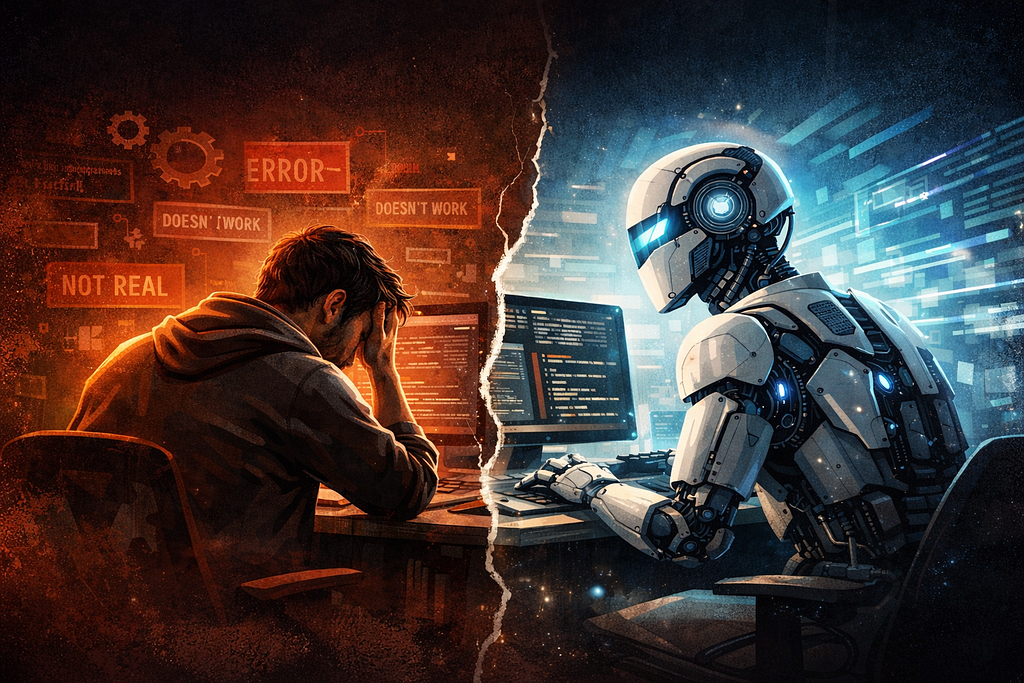
There’s a particular kind of resistance you see in the developer community right now that’s hard to watch. Not healthy skepticism — I’m all for that. Not thoughtful criticism of AI-generated code quality — that’s fair and necessary. I’m talking about something else entirely.
I’m talking about denial.
The kind of denial where a developer watches an AI agent build in ten minutes what would have taken them a day, and responds with “yeah but it won’t work in production.” The kind where someone dismisses Claude Code, Cursor, or Copilot without having spent a single hour using them. The kind where the argument isn’t “I tried it and here’s what’s wrong” — it’s “I refuse to try it because real developers write their own code.”
This isn’t a technical position. It’s an emotional one. And the developer community has been here before.
We’ve Seen This Movie
Every major shift in software development has been met with the same reaction: dismissal, ridicule, and the firm belief that this time the new thing won’t stick.
When Stack Overflow launched, experienced developers called it a crutch. “Real engineers read the documentation.” “You’re just copy-pasting answers without understanding them.” Sound familiar?
When open source gained momentum, enterprise developers dismissed it as amateur code. “No serious company would build on software maintained by random people on the internet.” Today, virtually every company on the planet runs on open source.
When cloud computing emerged, the resistance was almost identical. “I’ll never trust someone else’s server.” “It’s just a fad.” “Real infrastructure means you control the hardware.” AWS launched in 2006. Twenty years later, the companies that refused to move to the cloud are either gone or desperately trying to catch up.
When no-code and low-code tools appeared, developers were openly contemptuous. “That’s not real programming.” “It can’t handle anything complex.” Those tools now power a multi-billion dollar market, and the complexity bar keeps rising.
The pattern is always the same. A new tool lowers the barrier. The people who built their identity on that barrier feel threatened. They find technical reasons to dismiss it. The tool improves. They keep dismissing it. The market moves. They get left behind.
We’re watching it happen again, in real time.
The Numbers Developers Don’t Want to Hear
The 2025 Stack Overflow Developer Survey tells a story that should keep every software engineer up at night — not because AI is coming for their job, but because of the gap between what’s happening and what developers are willing to acknowledge.
84% of developers now use or plan to use AI tools. But only 29% trust the accuracy of AI output — down from 40% the year before. Positive sentiment toward AI dropped from 72% to 60% in a single year.
Read that again. Usage is going up. Trust is going down.
This is the textbook shape of denial. Developers are using these tools because they have to — because their colleagues are, because the market demands it, because the productivity difference is too obvious to ignore. But they resent it. They don’t want to admit that a machine can do a meaningful chunk of what they spent years learning to do.
And it gets worse. The vast majority of professional developers say “vibe coding” — generating entire applications from prompts — is not part of their professional workflow. Nearly half say they spend more time fixing “almost-right” AI code than writing from scratch. These are real criticisms. But they’re also criticisms that sound exactly like what people said about Stack Overflow answers fifteen years ago: “sure it works, but you don’t really understand it.”
The question is: does it matter?
The Market Doesn’t Care About Your Feelings
While developers debate whether AI agents are “real” software engineering, the market is making its own decisions.
Entry-level developer job postings have dropped roughly 67% from their 2022 peak. In the US, programmer employment fell 27.5% between 2023 and 2025 — though it’s worth noting this applies to “programmers” specifically, while “software developer” roles declined only marginally. Google and Meta are hiring approximately 50% fewer new graduates compared to 2021.
A Harvard study tracking 62 million workers found that junior employment at AI-adopting companies declined by 9–10% within six quarters of implementation. Senior employment stayed flat.
What does this mean? It means companies are already betting that AI agents can replace the output of junior engineers. Not in theory. Not in a blog post. In their actual headcount and hiring budgets.
You can argue that AI-generated code isn’t as good as human code. You might even be right — for now. But if a company can ship a feature in two hours with an AI agent instead of assigning it to a junior developer for two days, the quality bar shifts. “Good enough, fast” beats “perfect, slow” in almost every business context.
The developers who dismiss this as hype are making the same mistake as the enterprises that dismissed cloud as a fad in 2008. The technology doesn’t need to be perfect. It needs to be good enough. And it already is.
The Real Fear Nobody Talks About
Here’s what I think is actually going on beneath the technical arguments and the dismissive tweets.
For most developers, coding is not just a skill. It’s an identity. “I’m a software engineer” carries weight — years of learning, problem-solving, building systems from scratch. It’s a craft, and craftspeople are understandably defensive when someone suggests their craft can be automated.
But that emotional response is precisely what makes denial so dangerous. Because while you’re arguing that AI agents can’t do “real” engineering, three things are happening simultaneously: the tools are getting better, the market is adjusting, and younger developers are building their entire workflow around AI from day one.
The generation entering the workforce right now doesn’t have your attachment to writing code by hand. They’ve never known a world without Copilot. They’ll use whatever tool lets them ship fastest, and they won’t lose a second of sleep over whether it’s “real” programming.
That’s not a criticism of their approach. That’s the future arriving on schedule.
The Valid Criticisms — and Why They Don’t Change the Conclusion
Let me be clear: not all skepticism is denial. Some of the criticism of AI coding tools is legitimate and important.
Security is a real concern. AI-generated code is not inherently more secure — in many cases it’s less secure, because models hallucinate API calls, reference deprecated libraries, and generate code that looks correct but isn’t.
The “almost right” problem is real. Debugging AI-generated code that’s subtly wrong can be harder than writing it yourself, because the code looks competent. 45% of developers cite this as their primary frustration.
The open source sustainability threat is real. When AI agents consume packages without developers reading documentation or reporting bugs, the feedback loop that sustains open source breaks down. Maintainers like Daniel Stenberg have already taken drastic action — shutting down cURL’s bug bounty after AI-generated submissions flooded it. Others, like Mitchell Hashimoto with Ghostty, now reject drive-by AI-generated pull requests entirely.
These are serious problems that deserve serious attention. But here’s the thing: they’re problems with the current implementation, not evidence that the entire direction is wrong. Saying “AI code has security issues” is like saying “early cloud deployments had reliability issues.” True. And completely irrelevant to whether the shift was going to happen anyway.
The bugs will be fixed. The security tooling will improve. The models will get better. They already are, visibly, every few months. Betting against that trajectory is a losing position.
The Five Stages, Live on Twitter
If you spend any time on tech Twitter, Reddit, or Hacker News, you can watch the five stages of grief play out in real time across the developer community.
Denial: “AI can’t write real software. It’s just autocomplete on steroids.”
Anger: “They’re going to replace us with a machine that hallucinates function names.”
Bargaining: “AI is fine for boilerplate, but you’ll always need a human for the complex stuff.”
Depression: “Junior developer hiring dropped 67%. What’s the point of learning to code?”
Acceptance: “I use Claude Code for the boring parts and focus my energy on architecture and design decisions.”
Most of the developer community is stuck somewhere between denial and bargaining. The ones who’ve reached acceptance aren’t louder about it — they’re too busy shipping.
What the Smart Developers Are Doing
The developers who will thrive in this landscape aren’t the ones fighting AI. They’re the ones who’ve already reframed their role.
They’re treating AI agents as junior developers that work at inhuman speed but need supervision. They’re spending less time typing and more time reviewing, designing, and thinking about architecture. They’re learning to write better prompts, better specifications, better acceptance criteria — because the bottleneck has shifted from “can I write this code?” to “can I describe what needs to be built clearly enough?”
They’re also honest about what’s changed. They admit that an AI agent can produce a working CRUD API faster than they can. They admit that this changes the economics of their work. And they’re adapting — not because they’re excited about it, necessarily, but because they’re pragmatic enough to see where the market is heading.
This isn’t surrender. It’s strategy.
The Uncomfortable Conclusion
AI coding agents are not going to replace all software engineers. Complex systems design, nuanced architectural decisions, deep debugging, and the kind of creative problem-solving that requires understanding an entire business domain — these are not going away anytime soon.
But the work that many developers do day-to-day? The CRUD endpoints, the UI components, the configuration files, the boilerplate, the test scaffolding? That work is being automated right now, today, by tools that are available for free or near-free.
Denying this doesn’t make it less true. It just means you’ll be the last one to adapt.
The developers who dismissed Stack Overflow eventually started using it. The companies that dismissed cloud eventually migrated. The engineers who dismissed open source eventually contributed to it.
The same thing will happen with AI coding agents. The only question is whether you’ll adapt now, when it’s a competitive advantage — or later, when it’s a survival requirement.
I know which one I’d choose.