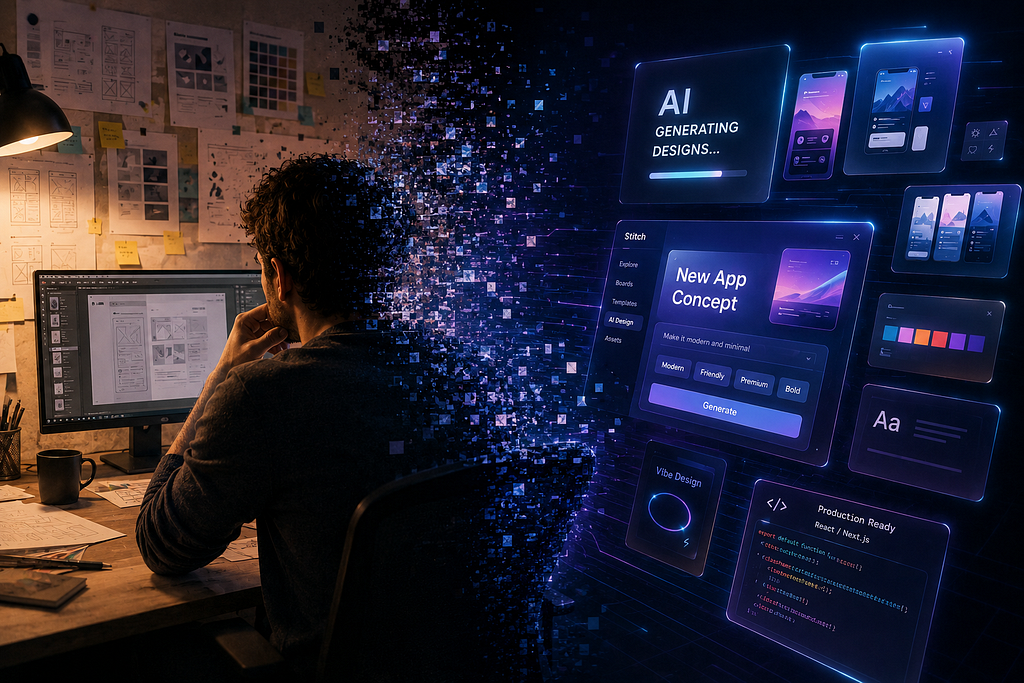
Somewhere right now, a design student is spending four hours perfecting the border radius on a card component. Adjusting padding by single pixels. Agonizing over whether the shadow should be 0 2px 4px or 0 4px 8px. Getting the spacing just right.
That student is training for a job that won’t exist by the time they graduate.
This isn’t speculation anymore. UX designer job postings have fallen 71% from their 2022 peak. UX research postings are down 73%. And while these numbers were dropping, Figma filed for a $68 billion IPO. Both things happened in the same era, and that’s not a coincidence — it’s the thesis of this entire article.
The tools are worth more than ever. The people who push pixels inside them are worth less.
The machines learned to design
Let me walk you through what happened in the last eighteen months, because the speed of it is easy to miss if you weren’t paying attention.
Figma shipped AI features that generate layouts, components, and entire design systems from text prompts. Not wireframes — polished, production-ready designs with proper spacing, typography, and color systems.
Google acquired Galileo AI and turned it into Stitch — a tool that generates high-fidelity UI from prompts on an infinite canvas. It introduced something called “Vibe Design mode”: you describe a business objective or a feeling you want the user to have, and it generates multiple design directions. No wireframes. No moodboards. No four-week discovery phase. Just results.
Vercel’s v0 went further — it doesn’t just design components, it generates production-ready React and Next.js code. Describe a pricing page, get a working pricing page. Not a mockup. A deployed page.
And these aren’t toys for prototyping. “89% of designers say AI has improved their workflow.” 58% of professional designers use AI generation tools at least weekly. The adoption curve isn’t gradual — it’s vertical.
”Vibe designing” is the new vibe coding
If you thought “vibe coding” was disruptive, meet its design twin.
Vibe designing is exactly what it sounds like: you describe the vibe, the AI designs it. A founder with zero design experience can now generate polished mobile app mockups that would have required hiring a designer just months ago. A product manager can create high-fidelity prototypes during a meeting. A developer can skip the “waiting for design” phase entirely.
The production layer of design — the mechanical work of generating layouts, resizing assets, adapting components across breakpoints, picking complementary colors — is being automated at a pace that makes the transition feel less like evolution and more like extinction.
And here’s the part that hurts: the AI is good at this. Not “good for a machine” good. Actually good. The layouts are clean. The spacing is consistent. The typography choices are sensible. The color systems are harmonious. It produces the kind of solid, best-practice design that took junior designers years to learn.
Which raises the question nobody in design school wants to ask: if AI can produce solid UI design from a prompt, what exactly are we teaching?
The three designers who survive
Not every designer dies in this transition. But the ones who survive look nothing like the ones we have today.
The System Designer. Someone who thinks in patterns, not pages. Who builds design systems — the rules, tokens, components, and constraints that govern how an entire product looks and behaves. AI is great at generating individual screens. It’s terrible at maintaining consistency across a product with 200 screens, three platforms, and an evolving brand. The system designer doesn’t draw the button. They define what a button means in this product, across every context it appears in.
The Taste Curator. AI generates options. Lots of options. Instantly. But it can’t tell you which one is right. It can’t feel that a layout is almost perfect but emotionally wrong. It can’t tell you that the spacing is technically correct but the page doesn’t breathe. Taste — the ability to look at ten AI-generated options and know which one serves the user and the brand — is a human skill. It’s also the hardest to teach and the hardest to automate.
The Interaction Architect. Someone who designs behavior, not appearance. How does the app feel when you swipe? What happens between screens? What does the loading state communicate? What makes a flow feel intuitive versus confusing? These are questions about human psychology, not visual design. AI can generate a beautiful screen. It cannot design a flow that anticipates how a distracted user with one hand free will navigate a checkout process while walking.
Notice what’s missing from this list: the person who spends their day moving rectangles in Figma. The person whose primary skill is “making it look right.” The person who takes a wireframe and produces a polished mockup. That job is over.
The identity crisis
Here’s where this gets emotionally difficult, and I want to be direct about it.
Design is an identity. “I’m a designer” carries the same weight as “I’m a developer” — it represents years of training, a specific way of seeing the world, a craft practiced and refined over thousands of hours.
When someone tells you that the craft you spent a decade mastering can now be approximated in thirty seconds by a prompt, the natural response is denial. “AI can’t design.” “It doesn’t understand users.” “It can’t be creative.” These are the same arguments developers made about coding agents eighteen months ago. And they were wrong for the same reason: the tools don’t need to be perfect. They need to be good enough to change the economics.
And the economics have already changed. Why would a startup hire a junior UI designer at €40K when the founder can generate equivalent output with Google Stitch during lunch? Why would an agency staff three designers on a landing page project when one senior designer with AI tools can do the work in a day?
The math doesn’t lie. And the job postings confirm it.
The design skill that matters most now
Design has overtaken technical expertise as the most in-demand skill in AI-related job postings — ahead of programming, cloud infrastructure, and data science combined.
But read that carefully. It says “design,” not “designer.” The skill is in demand. The traditional role is not.
What companies want is someone who can think in systems, curate quality, and make decisions about user experience at a strategic level — while leveraging AI tools to move at 10x the speed. They want the taste, the judgment, and the user empathy. They don’t want the person who manually creates the assets.
This is the gap. The industry values design thinking more than ever. It values pixel-pushing less than ever. And most designers built their career on the latter while assuming it was the former.
What design education should be teaching (but isn’t)
If I were building a design curriculum for 2026, here’s what would be in it:
Systems thinking. How to build and maintain design systems. How tokens work. How to create constraints that scale across platforms. This is where AI needs humans most.
AI collaboration. Not “how to use Figma” — that’s a commodity skill now. How to write effective design prompts. How to evaluate AI output. How to iterate with AI tools while maintaining brand consistency and accessibility standards.
User psychology. Not personas and journey maps — AI can generate those. Deep understanding of cognitive load, decision fatigue, attention patterns, accessibility needs. The stuff that requires empathy, not execution.
Business strategy. How design decisions impact conversion, retention, revenue. A designer who can articulate why this layout drives 12% more signups than that one is infinitely more valuable than one who can produce both layouts faster.
Curation and critique. The ability to look at AI output and articulate specifically why it works or doesn’t. Not “I don’t like it” — “this layout creates cognitive overload because there are three competing calls to action above the fold.” That’s taste plus vocabulary plus understanding.
What would not be in the curriculum: spending semesters learning to manually create mockups. That skill has the same future as handwriting assembly code.
The uncomfortable parallel
I’ve written before about developers being in denial about AI coding agents. The designer version of this denial is even more acute, because the visual output of AI design tools is closer to professional quality than AI-generated code is to production-ready software.
A vibe-coded app has bugs, security holes, and architectural problems. A vibe-designed interface looks… fine. Often better than fine. The delta between “AI output” and “professional output” is smaller in design than in engineering, which means the economic argument for replacing humans hits sooner and harder.
The developers who adapted early are thriving — they use AI agents for execution and focus their time on architecture and review. The same playbook applies to designers. Use AI for production. Focus your human time on system design, taste, and strategy.
But here’s the difference: when developers adapted, they kept their jobs and changed their workflow. When designers adapt, many of them will discover that the workflow they’re adapting to doesn’t require a full-time designer at all.
The last generation
The designers working today are the last generation that learned the craft the traditional way. They learned color theory from a professor, not a prompt. They learned typography by setting type, not by selecting an AI-generated option. They learned layout by building hundreds of pages by hand, developing an intuition that no amount of prompting can replicate.
That intuition is real. That taste is real. That judgment is real. And those are exactly the things that will still matter.
But the vehicle for applying them has changed permanently. The designers who will exist in five years won’t be “designers” in any sense that a 2020 designer would recognize. They’ll be system architects, taste curators, and experience strategists who happen to use AI design tools the way today’s designers use Figma — as a medium, not a skill.
The last generation of pixel pushers is working right now. Some of them know it. Most of them don’t. And the ones who figure it out first will be the ones who define what comes next.
The rest will be looking for work in a market that has 71% fewer openings — and shrinking.